Polarisation and protectionism: Does economic reality trump political rhetoric
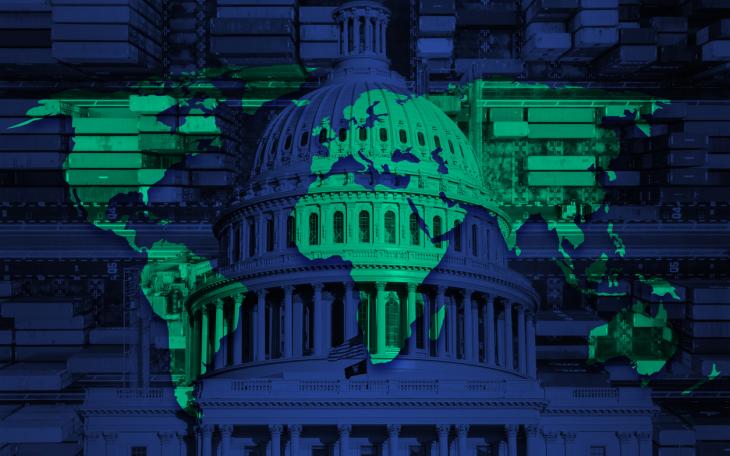

President Trump framed his State of the Union speech this week in praise of “America’s golden age.”
His second term in office is testing alliances and trade ties around the world. It’s brought into question, in a global era of polarised politics, the very idea of international unity or common ground.
The concept of spheres of influence by Great Powers, very reminiscent of nineteenth century history, looks to be firmly back on the agenda. In the words of President Trump’s influential White House adviser Stephen Miller, “the world is governed by strength.”
In Europe, a more muscular and protective tone is also apparent from the European Commission, based around the idea of the proactive promotion of European industrial champions to compete with American and Chinese companies.
The UK business secretary Peter Kyle in Brussels this week urged European allies to stop “putting up barriers” but made it clear he was also keen for UK to be included in the new Made in Europe Scheme. This envisages “Buy European” rules for public procurement and government subsidies to safeguard domestic manufacturing.
I’m currently reading a fascinating account by Edward Fishman, a former US trade official of how over the past few decades the US Government has developed the concept of Chokepoints, in their dealings with states such as Iran and Russia. This involves using control of the global financial system and the supply of vital goods and services to exert political pressure.
But it seems it can cut both ways. The Geostrategic Europe Taskforce last week published a report last week which identified 41 EU chokepoints where China depends on the EU for 80% of its imports and a total of 67 areas where the EU can exert similar economic pressure or chokepoints on the USA, that includes medical supplies such as insulin.
So are we now dealing with a world of unreliable and competing great powers. Has distrust and disillusion displaced co-operation as the new global default?
I’m not so certain. It’s easy to despair about the state of global collaboration climate change if one only focuses on media headlines. In the USA the legal changes which have seen the removal of the 2009 endangerment finding which viewed greenhouse gases as a threat to human health is just one recent example.
A Yale poll still finds that three quarters of registered US voters think that their Federal Government should continue to regulate CO2 as a pollutant.
But outside Washington, it’s economic reality not ideological choice that is changing America today.
Clean Tech keeps getting cheaper. Fracking has made natural gas cheaper than coal and Chinese manufacturing has made solar cheaper than gas. Investment banks commit capital while retreating from climate coalitions. It means that US carbon emissions have fallen by up to a fifth compared with twenty years ago. Economic reality continues to trump political rhetoric.
What to read next
Browse below for the latest news, insights and thought leadership from our team of experts
It’s about housing, stupid

Budget 2026: What’s in store for developers?

Delegation Nation
Reframing Britain’s Brexit debate

The missing sector in Britain's growth strategy

Pacific Pre-COP31: Testing the waters ahead of Turkey

How communications drives deal outcomes

Vibes win the click. Only substance wins the trust.