Proceed with caution! Lessons for writers using AI
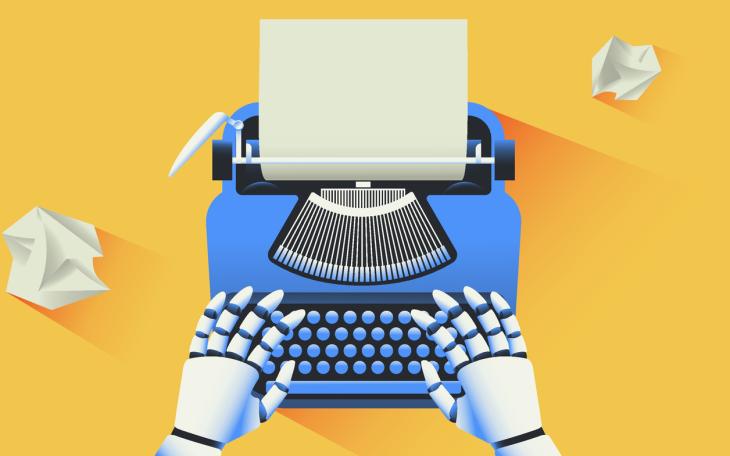

As a copywriter, it’s hard to talk about writing – as a skill, as a service – without talking about AI.
In many workplaces, the use of AI tools has become as normal as using Google or Microsoft Word. According to the British Chambers of Commerce (BCC), more than half of UK firms (54%) are now actively using AI, up from 35% of firms in 2025, 25% in 2024, and 23% in 2023. So, a big jump in the last 12 months.
AI is excellent at turning a jumble of notes into coherent copy in seconds; it can help us get through repetitive tasks more quickly or analyse vast swathes of information at scale.
The problem is that, as consumers of content, we are much less comfortable with what AI generates. By now, most of us will have had the experience of reading something, only to immediately suspect it is AI generated. The copy may be superficially well written, but it is usually dull, lacking the edge and stylistic quirks of a human author. We just don’t like to read writing like this – it gives us the ick. It’s the literary equivalent of the ‘uncanny valley’ effect.
Earlier this year, City AM published an article by its deputy comment and features editor, Anna Moloney, called ‘There should have been an op-ed here, but you filed AI slop’, which railed against AI-generated copy. All articles sent to City AM are being run through AI-detection software, she says, and we won’t publish them if they’ve not been written by a human. As she puts it: “If you can't be bothered to write it, why should anyone be bothered to read it?”.
And it is not just the media outlets that object to AI-generated content. Recent research from the London School of Economics found that, whilst voters don't mind politicians using AI to analyse data or help with campaign operations, they really do not like it when politicians use AI in place of their own voice. The study found that 42% of respondents think using AI to write campaign materials is unacceptable, while 41% feel the same about AI-generated images and videos.
For those of us working as copywriters or in communications, these attitudes are reassuring. Our skills – honed, often, over years of practice – are still prized. In a world flooded by AI-generated content that, clearly, no one trusts and no one wants to read or indeed publish, the ability to write well may become increasingly valuable. I suspect that most of us thought the dial would move the other way, so I, for one, am delighted by this turn of events.
Still, I don’t think this means we should stop using AI – it is incredibly useful when used appropriately. But we should be handling this technology with care. Just because you did something quickly and it doesn’t suck, doesn’t mean it’s good.
As copywriters, the authors of op-eds, or the communications specialists supporting with the creation of those articles, we need to remind ourselves that it is our innate humanity that makes our writing engaging.
When we read AI-generated copy and compare it with our own, we may feel our words lack that polish that AI is so good at producing. But what our words lack in polish, they gain in authenticity and warmth, humour and nuance. Conversely, and as Micah Nathan wrote in The Guardian, “AI’s prose is perfectly mediocre, producing the sort of inert gloss that reads like a Frankensteinian amalgam of…workshopped writing, an unintentional parody of the style it mimics”.
We must also remember that writing is not for the author, but for the reader. Good copy will capture attention and engage the right audience; it will spark new ideas and inform, challenge biases or support opinions. So, if your audience doesn’t want to read your writing because, in fact, AI wrote it, then it’s not writing – it’s just words on a page.
What to read next
Browse below for the latest news, insights and thought leadership from our team of experts
It’s about housing, stupid

Budget 2026: What’s in store for developers?

Delegation Nation

Pacific Pre-COP31: Testing the waters ahead of Turkey
Vibes win the click. Only substance wins the trust.

How communications drives deal outcomes

The missing sector in Britain's growth strategy

Reframing Britain’s Brexit debate