The changing boundaries of privacy

Recent discussions about online safety have rightly focused on protecting children and young people. But the wider issue of digital exposure does not begin or end with social media. It has become part of the infrastructure of daily life, affecting almost every search we make, service we use and connected device we bring into our homes.
When I search for something online, the activity can contribute to my digital profile. Cookies and similar technologies connect behaviour across websites and devices, helping businesses understand my interests and determine the advertising or content I subsequently see.
This exchange has gradually become familiar: I receive a quicker, more personalised experience, while platforms learn more about my behaviour.
The same dynamic has since moved beyond the screen. Alexa and other voice assistants wait for spoken instructions inside our homes. Smart televisions respond to our viewing habits, watches collect information about our health and movement, and connected doorbells record activity outside our front doors.
This does not mean every device is continuously recording and retaining every conversation. However, it has become increasingly difficult for an ordinary user to understand what information is being collected, when processing begins, how long the data is retained or who may ultimately have access to it.
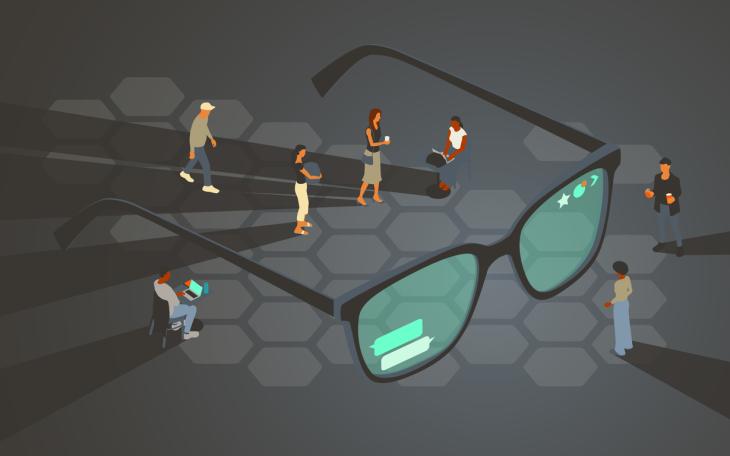
Meta’s smart glasses take this development a significant step further by making connected technology wearable and far less visible.
The glasses allow users to take photographs, record video and ask an AI assistant questions about what they can see and hear. Their conventional Ray-Ban design is fundamental to their appeal. It also makes it much harder for the people around the wearer to recognise that they may be interacting with a camera, microphones and an AI-enabled device.
This is no longer a niche concern. EssilorLuxottica, which produces the glasses with Meta, reported that more than seven million pairs of its Meta-enabled AI glasses were sold during 2025 - a clear indication that wearable AI is moving rapidly towards the mainstream.
Meta includes an LED light to indicate when recording is taking place and has introduced technology intended to prevent filming if the light is covered. Yet reports that some users have attempted to disable or obscure the indicator demonstrate the limitations of relying on a technical safeguard to establish social consent. Meta recently disabled camera functionality on thousands of glasses found to have been modified.
The concern is not simply that I could appear in someone else’s video. AI-enabled glasses can interpret their surroundings, respond to questions and process what a wearer sees or hears. I may therefore become part of an interaction with an AI system without knowing it is happening, let alone agreeing to participate.
Regulators are beginning to respond. The European Data Protection Board has identified smart glasses as an increasingly important privacy issue. It has agreed to prepare public-facing recommendations addressing their key data-protection challenges and highlighting appropriate safeguards. Courts across England and Wales have also prohibited Meta smart glasses because of concerns about unauthorised recording.
Existing policies covering mobile phones, photography and confidential information may no longer be sufficient. Organisations must explain their approach in a way that recognises both the legitimate uses of wearable technology and the concerns of those who have not chosen to engage with it. A policy may be legally compliant, but it can still attract criticism if it appears to place convenience above consent.
Smart glasses can offer valuable support with accessibility, navigation, training and hands-free communication. I do not believe the answer is to reject the technology outright. However, its development must be accompanied by greater transparency and clearer expectations about its use.
For years, privacy has been presented as something we can manage through settings, permissions and personal choices. Wearable AI reveals the weakness in that argument. We may be able to control the technology we use, but we have far less control over the technology being used around us.
What to read next
Browse below for the latest news, insights and thought leadership from our team of experts

The politics of presence: Why institutions need to be seen to be trusted

The CEO transition tightrope: How to signal change without undermining trust

Built to last? JLR redundancies challenge the government’s industrial ambitions

Time to plug in baby (solar goes mainstream)

Housing Delivery Test results: the focus shifts from planning approvals to housing delivery

Back to school and the term ahead

Back to school for Number 10 as Burnham’s autumn test begins

The end of upward-only rent reviews could change how investors see real estate