Merz's election setback and what it means for Germany

By Jacopo Pastorelli
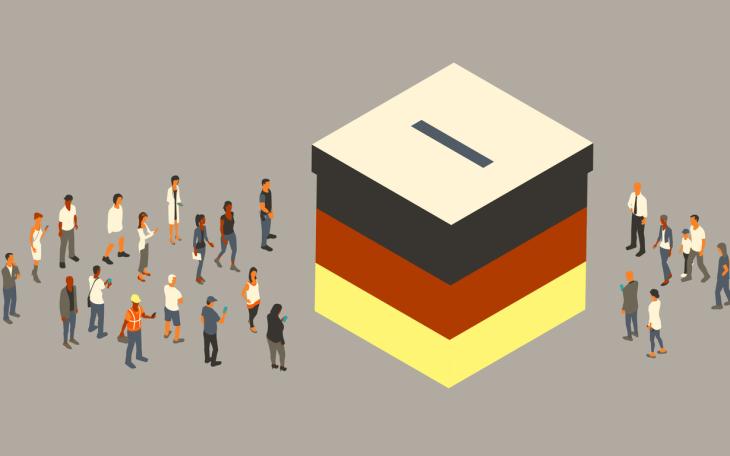
Germany's September state elections delivered a fresh setback for Chancellor Friedrich Merz and his Christian Democratic Union (CDU) party. In Mecklenburg-Western Pomerania, the CDU failed to clear the 5% threshold needed to enter the regional parliament, while the Alternative for Germany (AfD) party secured its second state election victory in a month.
Whilst the result may not immediately unseat Merz, his low approval ratings and the AfD's surge have left his future hanging in the balance, highlighting the continued rise of Germany's political extremes.
SEC Newgate Germany’s Jacopo Pastorelli takes us through the results below.
The latest from Berlin & Mecklenburg-Western Pomerania
The September 20th elections in Berlin and Mecklenburg-Western Pomerania reinforced the electoral fragmentation seen in Saxony-Anhalt two weeks earlier.
In Berlin, the Left won the election with 25.7%, followed by the CDU with 18.8%, the AfD with 16.3%, the Greens with 14.3%, and the Social Democratic Party (SPD) with 12.1%. The result ended the CDU-SPD majority and gives the Left the opportunity to lead the next city-state government and appoint Berlin’s mayor. Both a Left-Green-SPD coalition and a CDU-Green-SPD coalition could command a majority. Housing policy, particularly proposals to bring large housing companies into public ownership, is expected to be a key sticking point in coalition negotiations.
In Mecklenburg-Western Pomerania, the AfD finished just ahead of the SPD, with 38.2% and 35.5% of the vote, respectively. This was followed by the Left with 6.5% and the Greens with 5.7%, while the CDU narrowly missed the 5% threshold needed for parliamentary representation for the first time in its history, with 4.9%. A late recovery by the SPD narrowed the AfD’s lead and allowed State Minister-President Manuela Schwesig to remain in office. Schwesig campaigned against the federal government’s reforms, positioning herself as a regional counterweight to Merz’s energy and economic agenda, distancing the state SPD from the unpopular federal coalition.
What this means at a federal level
The old West German party system is in free fall. The results in Berlin and Mecklenburg-Western Pomerania reinforce the profound shift away from Germany’s traditional CDU, Christian Social Union (CSU) and SPD axis. The Left’s surge and the AfD’s emergence as the leading party in two states show voters increasingly moving towards political poles, rather than the traditional centre.
The CDU, CSU and liberal Free Democratic Party (FDP) once regularly commanded a majority of the national vote. Together, they represented the traditional German ‘bourgeois camp’, associated with economic liberalism, conservative values, technological modernisation, fiscal discipline and Germany’s Western orientation. They now represent only around a quarter of the electorate. The next major test of this decline will come in April next year, when North Rhine-Westphalia, Germany’s most populous state, goes to the polls.
While Chancellor Merz may have survived the election night, his leadership is being questioned. The CDU's failure to clear the 5% threshold in Mecklenburg-Western Pomerania is a historic setback for the party that will be hard to ignore. Merz has ruled out resigning, but internal party reports suggest leadership discussions are under way, despite there being few credible alternatives.
Replacing a sitting Chancellor would also be politically challenging. Merz could resign voluntarily, which he has ruled out, or the Bundestag could replace him through a constructive vote of no confidence. Still, any replacement Chancellor would also need the SPD’s support in a coalition with an already slim majority.
The results underline the continued erosion of Germany's traditional political centre. Support for the CDU and FDP has fallen significantly in recent years. Meanwhile, the AfD’s stance on the economy, migration, security and national identity, are appealing to voters, despite concerns about its political agenda being at odds with Germany’s integration into European markets. The emerging political vacuum extends beyond left versus right, it signals a contest over what a new economically credible centre should look like.
What happens next?
Berlin will test whether the Left can turn electoral success into governing credibility through an agenda focused on greater public ownership and intervention, rather than market-based expansion. The Left’s victory gives it the strongest mandate, but a likely SPD-Green-Left coalition would need to reconcile different positions on housing, fiscal policy,and the cost of living.
Meanwhile, the CDU must decide how to sharpen its conservative profile to win back voters from the AfD, while maintaining its firewall policy, and remaining a credible option for centrist voters.
In Mecklenburg-Western Pomerania, the SPD could remain in government with the Left and the Greens, but a new coalition would face an emboldened AfD. The SDP would need to deliver quickly on economic development, infrastructure, and public services to present a credible alternative.
Having lost representation in the state parliament, the CDU is now facing a deeper challenge in eastern Germany than simply recovering from a poor election campaign.
What to read next
Browse below for the latest news, insights and thought leadership from our team of experts

Ed Sheeran’s case study on the death of strategic neutrality

From manifestos to bricks and mortar: how do we get more homes built?
From coalition to collapse...and back again?

Framing the narrative in favour of Jackdaw

From Manchester to Manhattan: Andy Burnham's Trump test
The art of the teal
Pay to stay: can England’s mayors follow Manchester’s lead and turn a ‘tourist tax’ into growth?
All change on local government reorganisation