All good things must come to an end


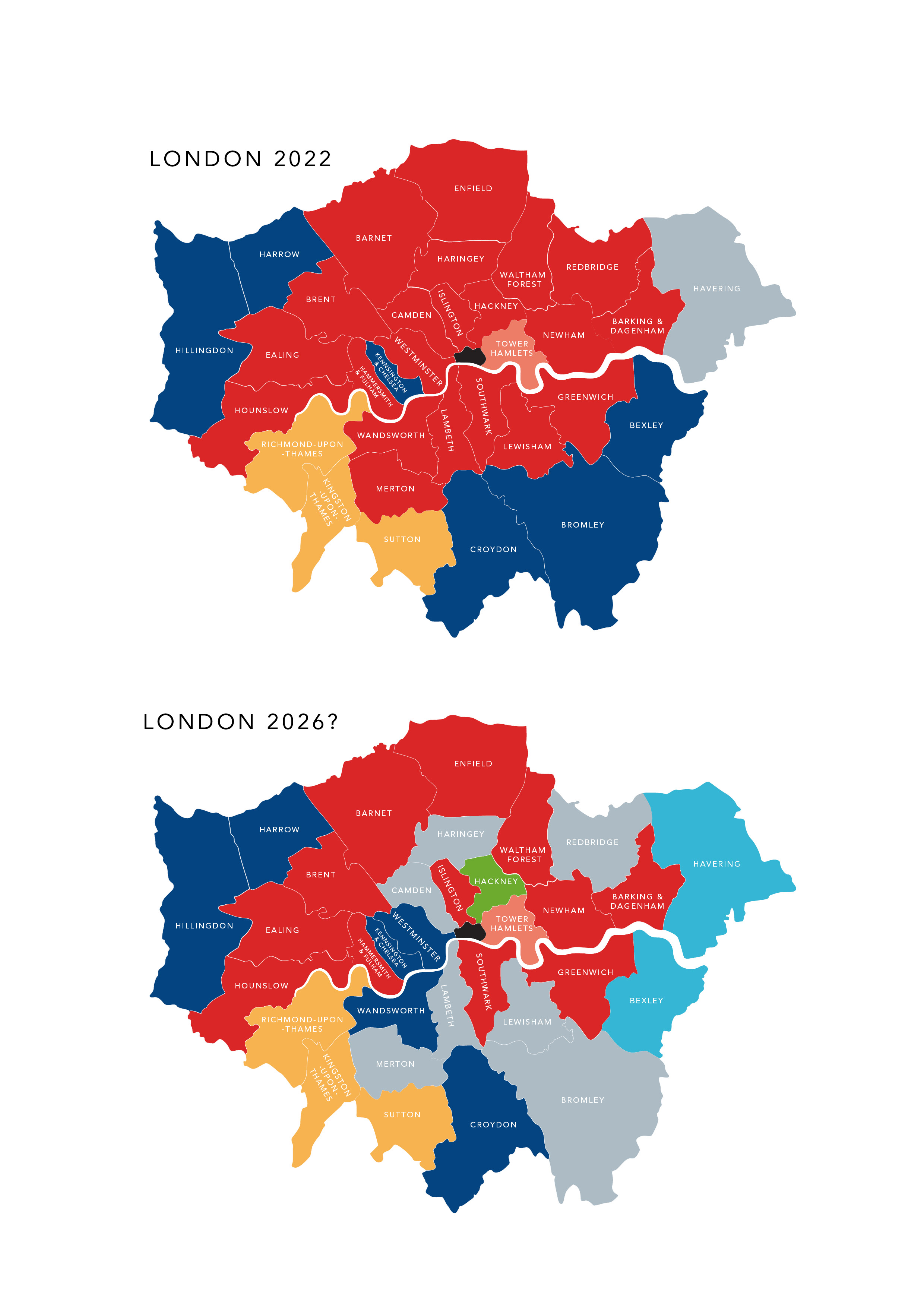
As we head into what could be considered ‘mid-term’ elections, it is obvious there will be significant change in the capital. Polling is pretty accurate these days and the broad sense is correct: Labour is under significant pressure in boroughs it has held for decades, will lose a large number of councillors, and possibly control of some councils. The two upstarts in the Greens and Reform will have good nights, with Reform mainly eating into the Conservative vote.
Talking to Labour councillors in the last 12 months, opinions have ranged from “some of us in the marginals will lose seats, get over it” to “we are all going to lose our seats” laments. But overall, the sense has been walking into danger without a clear sense of how to deal with the threat they must have known was coming.
Parties in power nationally tend to suffer at local level, and this is a particularly unpopular government. Support has leaked left, right, and centre. We have become used to Labour domination in London, but it was not always the case. As recently as 2006, Labour only won majority control in seven councils. Then the issue was the Iraq War and the Lib Dems and Conservatives benefitted.
There remains a lot of uncertainty in the scale of the loss, and many boroughs are genuine toss-ups to the extent that accurate ward by ward predictions are near impossible in a way they have not been in a long while. But Labour bastions like Hackney, Haringey, Islington, Lambeth and Lewisham are feeling the pressure – a massive turnaround from winning almost all seats in a borough.
Luckily for Labour, a great deal of margin for error has been built up in the last 14 years. Large seat majorities in boroughs, and vote majorities in wards. Where Labour hangs on, it may do so with vastly lower majorities on the council, and a sigh of relief. We will then find out whether immediate recovery is possible, or the trajectory is further downward.
Greens are campaigning hard and professionally in its target wards. Many Corbyn-supporting Labour members left when the party changed direction under Keir Starmer. They joined the Green Party in large numbers, elected Polanski to take it in their desired direction, and will ride dissatisfaction with the government as far as it takes them.
Importantly, the Greens now have Proof of Concept: Gorton and Denton didn’t change the Commons arithmetic, but it proved to left-leaning voters that they could safely vote Green without necessarily handing control to ‘the right’ as Labour had claimed. Meanwhile, the same is true of community-based independents in Redbridge or Newham. Related to that, I suspect Labour will do best where the contest has been, even in 2022, “traditional” red/blue. Think Hammersmith, Hounslow, Ealing, Enfield. This isn’t necessarily enough to hang on in Barnet or regain Croydon, just suggests an absence of collapse as tactical voting remains in play.
The Conservatives were badly beaten in 2022, finally losing the totemic councils of Westminster, Wandsworth, and Barnet. Winning those back would be very welcome as a minimum for the national leadership, as there is trouble in the ‘outer ring’ (Westminster is odds-on). They have not yet recovered to be a broad-based party, putting its control at threat in outer boroughs Bexley and Bromley where Reform is doing well. A large Reform vote in Barnet may split the right and allow Labour to retain the council even with a decreasing vote. Over in Havering, the Reform juggernaut threatens the long-standing Residents Association presence – they were always likely to be competing for the same votes, with not enough space for two populist-right parties.
And what of the previous (2002-2010) recipient of “protest votes” in London, the Lib Dems? They are no longer fishing in that pond with the Greens. But if the Lib Dems hold the small number of seats they have in inner London boroughs, they could find themselves in power supporting either Labour or the Greens. After 16 years locked out in many boroughs, I expect they will relish the chance. The currently-held councils in south-west London should be easy holds.
Post-May
The noted fragmentation of politics and difference in how the Green vote behaves is likely to result in more ‘split wards, and more No Overall Control (NOC) councils. This poses significant challenges to development and communication.
In general, NOC is not good for development. This is because planning is inherently political. That’s not only about the numbers making up the planning committee. Development from large regenerations to small infill housing requires the drive and desire to make things happen. In short: political leadership. This is made much more difficult when you don’t have a majority, everything must be hammered out with opposition, and the short-term gains of obstruction become even more obvious. At an event in Hove last month, Deputy Leader of Brighton and Hove City Council Jacob Taylor responded in a similar way to a suggestion to the floor for a “cross-party approach to big planning decisions”. On the contrary, the evidence is that majority control promotes the necessary decision-making, NOC does the opposite.
The loss of experience we expect will also have an impact. Many incoming councillors will be surprised by what the role entails. There is little to no training for councillors. Whatever their original political mission, new councillors will be faced by the facts of life as told to them by the Section 151 Officer, the Head of Planning, and other heads of services. All without the knowledge of how to bend a large bureaucracy to their will (and for the Greens, usually without the benefit of a functioning Group Whip). There are several ways this can play out, none of which remove the need for early and effective engagement with all relevant political actors.
What to read next
Browse below for the latest news, insights and thought leadership from our team of experts

Pensions reform in focus

Data Centres - Will we learn from the past?

Profit warnings and the importance of context

Delhi's protest. India's growth story.

It’s about housing, stupid

Budget 2026: What’s in store for developers?
Delegation Nation

Reframing Britain’s Brexit debate