The high price of hyperbole
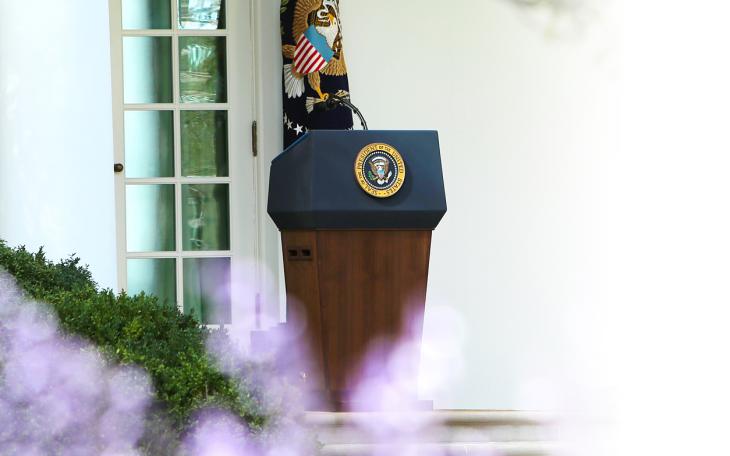

There was a time when a presidential announcement made the world react. Markets moved, politicians and ambassadors cancelled dinner plans and government departments issued statements expressing various levels of “support” or “concern”. In recent months however, it seems that when confronted by yet another “hyperbolic” declaration from the White House, the world is increasingly inclined to put the kettle on and wait it out.
This is partly a consequence of what Steve Bannon called “flooding the zone”: overwhelming the media and political system with such a volume of claims, initiatives and controversies that no single story can dominate for long. As a method of capturing attention, it has been remarkably effective. As a method of sustaining credibility however, its effectiveness is less clear.
Consider tariffs. President Trump’s “Liberation Day” announcement in April 2025 initially sent markets sharply lower and governments scrambling for a response. In August 2026, reactions to President Trump’s declarations are notably more muted from world leaders. Brussels in particular, appears to have discovered the strategic possibilities of doing very little (in public). Faced with fresh tariff threats, European officials have increasingly favoured patience, dialogue and delay over theatrical retaliation. The problem is not always an absence of action. It is the repeated mismatch between the magnitude of the announcement and the action that eventually follows.
Similarly, Iran has acquired the unusual diplomatic privilege of several final warnings. Each may have been intended to increase the pressure but collectively they seem to have taught Tehran that the safest response to an ultimatum is to just wait for the revised version.
It is probably fair to say that a threat does not have to be implemented exactly as advertised to create leverage and a maximalist announcement may still succeed as a negotiating device while failing as a statement of actual intent. NATO spending is a good example in which maximalist language arguably had the intended effect. The difficulty is that over time audiences learn. Once they recognise a pattern, they stop responding to the words and begin calculating the probable settlement.
The corporate parallel is imperfect but useful. Unlike presidents, chief executives do not command aircraft carriers and most results presentations stop short of threatening total annihilation. Yet both depend on the willingness of other people to believe that an announcement carries consequences.
For corporate communicators, the danger is announcement inflation. If every contract is transformational and every set of results are landmark, the genuinely important news arrives dressed identically to everything else. Journalists become harder to interest and investors will wait for the proof. What was intended to convey momentum instead runs the risk of being diluted.
Credibility is also cumulative. Stakeholders do not assess today’s promise in isolation; they compare it with the previous dozen. A delayed target or quietly abandoned strategy teaches an audience to reserve judgement. In time, even accurate announcements attract what might be called a credibility discount – a gap between what an organisation says and what its audiences are prepared to price in.
The lesson is not that leaders should retreat into monastic silence. Nor is it that bold announcements never work. It is that communications should have a hierarchy. The biggest language should only be reserved for the biggest moments, and claims should arrive with proof and somebody visibly accountable for the delivery.
Flooding the zone can ensure that everyone is listening, but if used too often, it may also ensure that nobody feels obliged to react.
A postscript: While drafting this piece, I asked ChatGPT to find a definition from Ambrose Bierce’s The Demon’s Dictionary that might fit the argument. It failed to find one worth including but compensated by inventing an excellent one of its own that nicely sums things up: “Credibility, n. - The expectation that today’s declaration will survive until tomorrow.”
What to read next
Browse below for the latest news, insights and thought leadership from our team of experts

Protecting trust in an age of AI and impersonation

A recovery measured in discipline, not exuberance: Views from the property sector’s EXPO REAL
An Iron Dome and an Iron Lady: Reflections on the Conservative Party Conference

Going for the Grid: Burnham tries to take back control

Your First Home: a helping hand for buyers or a boost for housebuilders?

Solar and Storage Live: The shift from tick-box consultation to meaningful engagement
Burnham goes big in first conference speech, but real test still lies ahead at the Budget

Why dark social matters more than ever