Planning and Infrastructure Act: opportunity, flexibility and a shift in culture
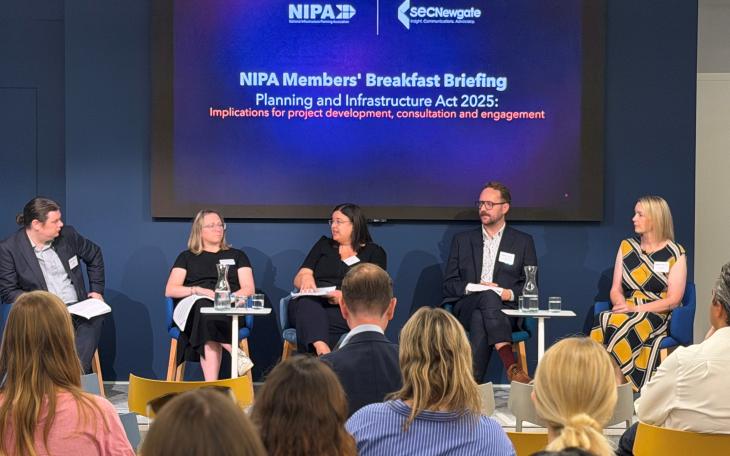

We were delighted to host members of the National Infrastructure Planning Association (NIPA) for a breakfast event last week looking at the implications of the Planning and Infrastructure Act for project development, consultation and engagement. Bringing together an expert panel including Anna Sutherland-Bamber from Iceni Projects, Claire Brodrick from Pinsent Masons, Michael Baker from RWE, Peta Donkin from Arcadis and chaired by SEC Newgate's Doug Johnson, the session focused on how practitioners are responding to the changes in practice. With the new National Infrastructure Planning Guidance coming into force on 24 July, this was a timely discussion on reforms that are set to influence how infrastructure projects are developed and consented for years to come.
A central theme of the discussion was that the new guidance creates greater flexibility for applicants and advisers to develop approaches tailored to individual projects, rather than following a highly standardised process. Panellists argued that there is an opportunity to rethink assumptions around project programming, stakeholder engagement and technical workstreams, with environmental impact assessment (EIA) scoping highlighted as one example where timing could become more flexible. This, in turn, may allow engagement to be undertaken when project impacts are better understood and discussions can be focused more effectively on project-specific issues.
Consultation and engagement featured prominently throughout the conversation. While the reforms are intended to streamline processes, panellists were clear that meaningful engagement remains critical. The consensus was that effective pre-application consultation will be essential if applicants want to reduce the number of issues requiring detailed examination. Earlier engagement, undertaken while projects are still evolving, was identified as one of the most significant opportunities arising from the reforms. This approach could give communities and stakeholders a greater opportunity to influence proposals before key decisions are fixed, while enabling applicants to draw on local knowledge earlier in project development. However, it will also require project teams to become more comfortable engaging in situations where not all answers are yet available.
The discussion repeatedly returned to the need for behavioural and cultural change. Panellists argued that realising the benefits of the new framework will require applicants, advisers, regulators and consultees to move beyond established precedents and embrace more flexible ways of working. Greater alignment between design, technical and engagement teams was seen as particularly important, while examining authorities and statutory consultees will also have a role in ensuring that resources are focused proportionately on genuinely project-specific issues.
Although there was enthusiasm about the potential for more focused examinations, participants were cautious about assumptions that examination periods would necessarily become shorter. Instead, the emphasis was on improving the quality of pre-application work so that examinations can concentrate on the issues that matter most.
The overarching conclusion was that the reforms present a significant opportunity to place greater emphasis on outcomes rather than procedural compliance. However, success will depend on how the guidance is implemented in practice and whether the sector is willing to embrace its spirit rather than simply recreating previous approaches under a new framework.
What to read next
Browse below for the latest news, insights and thought leadership from our team of experts

The art of the teal

Pay to stay: can England’s mayors follow Manchester’s lead and turn a ‘tourist tax’ into growth?

All change on local government reorganisation

From drought to disruption: Why adaptation matters now

Australia's AI chart crackdown signals a wider shift in trust and disclosure

From Waiting for Godot to winning trust: Communications lessons from IPEM 2026

Farage, Burnham, and the battle for authenticity

What Aristotle can tell us about corporate statements