Utility Week Live: One voice has set the agenda
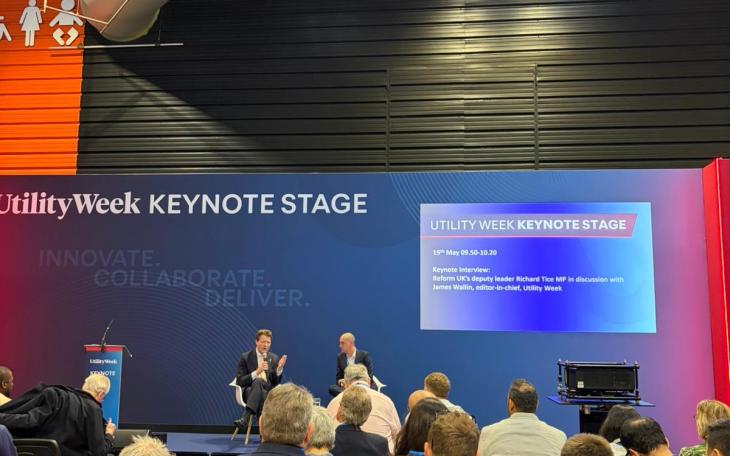

At Utility Week Live in Birmingham’s NEC this morning, the queue for the opening keynote snaked around the hall – and it wasn’t for the free coffee. The draw was Richard Tice MP, Energy Spokesperson for Reform UK, whose standing-room-only session set the tone for a day defined as much by politics as by policy. As attendees queued past stands showcasing renewables, grid tech and supply-chain innovation, each vying for attention, the contrast was clear: inside the keynote area, the debate was about direction, whereas outside, it was about delivery.
With no senior Conservative or Labour speaker following him (after Shadow Energy Secretary Claire Coutinho pulled out this morning, and with no Labour representative on the billing), Tice effectively became the voice to respond to.
Framing utilities as “the bedrock of how the country works”, he offered a blunt critique of what he characterised as policy that is “daft, dithering and delayed”. His message was deliberately provocative, and judging by the hecklers, successfully so. Net zero, he argued, is the “wrong course”, urging a return to what he sees as proven, lower-cost energy sources: “If it ain’t broke, don’t fix it,” he said.
While acknowledging the appeal of new technologies, he questioned the economics of renewables where subsidies persist, and emphasised the continued dominance of oil and gas in the UK’s energy mix for decades to come. “I love tech, I have a Tesla,” he added, “but that’s because it’s great tech, not because it’s net zero.”
It was a populist intervention, but an effective one. Tice didn’t just critique policy; he issued a direct invitation to industry to help rewrite it, asking for input on regulations to cut and proposing structural reforms (challenging anyone with a view to share a “three-page proposal” on regulation, and stating that “all options are on the table”), from expanded oil and gas exploration to new long-term investment models for infrastructure. The result was less a keynote than an agenda-setting moment, filling a space left open by absent voices who may or may not be focused more on Westminster wrangling, or perhaps, the by-election that will be happening up the road in Manchester.
The sessions that have followed have spent the day grappling with that challenge. Industry leaders and experts largely rejected the idea of abandoning net zero, but they implicitly acknowledged the pressure points Tice had exploited. The dominant theme has been “balance”, and how to maintain momentum on decarbonisation while strengthening energy security, affordability and resilience. Rather than wholesale shifts, speakers advocated for an “agile but consistent” path, one that can flex with geopolitical and economic shocks without losing strategic direction.
What emerged was a more complex picture than the binary framing of the keynote. Flexibility, especially in grid infrastructure and energy systems, has been repeatedly flagged as critical, albeit difficult to communicate. These are investments that don’t lend themselves to ribbon-cutting moments or political wins, yet they underpin the entire system. Similarly, discussions on global supply highlighted the importance of optionality, from scaling UK renewables to exploring imported clean energy, reinforcing that resilience lies in diversification rather than dependency.
The water sector faced a parallel reckoning. Industry leaders openly acknowledged a trust deficit and the weight of ageing infrastructure. The central dilemma is clear: as one beleaguered water CEO put it, how do you prioritise upgrading Victorian-era systems while meeting rising environmental and regulatory expectations? The consensus was to be pragmatic, focusing on core infrastructure, even where trade-offs are unavoidable.
On renationalisation, the mood was cautious; while the current model is under strain, few were convinced that transferring responsibility to government would resolve the underlying investment challenge. In a period of competing pressures, from stretched public services to rising defence spending, there was a question as to whether water would secure the sustained funding it requires from the public purse.
For communicators, today has offered a clear lesson in narrative control. Tice’s keynote demonstrated the power of a simple, assertive message to shape the conversation, particularly in the absence of competing voices. Tice got in early, landed his key points, and left, and still several hours later, his speech continues to echo around the NEC, and is being referenced in many of the subsequent panels.
Encouragingly, the exhibition floor demonstrated plenty of industry engagement. Interactive displays and hands-on demos translated complex, often invisible infrastructure into something tangible and relatable. One minute I was operating a full-sized digger to knock over skittles and pick up ducks, the next I was unblocking drains, before observing a drone fly through a sewage pipe. It was a reminder that effective communication isn’t just about argument, but also about accessibility, and it is clear that the utilities industry is full of innovation.
Ultimately, Utility Week Live underscored a growing reality: this is no longer just a delivery challenge, but a narrative one. The sector has the technical solutions (and plenty of ambition), but in a more politicised and contested environment, this is no longer enough. The organisations that will shape the future of utilities won’t only be those that build infrastructure, but also those that explain it, defend it, and make it matter to the public. Because if the story isn’t being told clearly and convincingly, it won’t stay untold, but it will simply be told by someone else, who may well have different views.
What to read next
Browse below for the latest news, insights and thought leadership from our team of experts

Protecting trust in an age of AI and impersonation

A recovery measured in discipline, not exuberance: Views from the property sector’s EXPO REAL
An Iron Dome and an Iron Lady: Reflections on the Conservative Party Conference

Going for the Grid: Burnham tries to take back control

Your First Home: a helping hand for buyers or a boost for housebuilders?

Solar and Storage Live: The shift from tick-box consultation to meaningful engagement

Burnham goes big in first conference speech, but real test still lies ahead at the Budget

Why dark social matters more than ever