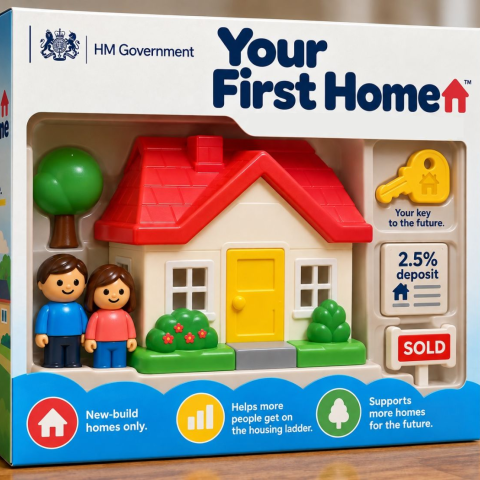
Vibes win the click. Only substance wins the trust.

What do Prime Minister Andy Burnham and M&S cookies have in common?
Vibes. Whenever I catch myself doomscrolling on TikTok, the new Prime Minister inevitably turns up. He is either ranking pub snacks with his Chancellor or talking through the latest policy over a cuppa. He is always up to something, and never behind a lectern communicating in press release lingo.
Gen Z has a habit of adding -maxxing to everything: looksmaxxing, sleepmaxxing, healthmaxxing. As a resident Gen-Zer, allow me to add one more: ‘vibesmaxxing’. It means winning people over with how you make them feel before you tell them what you will do. In politics, you may have heard this referred to as vibes politics. For businesses, vibes are one of the most powerful forces in communications right now, but one of the easiest to get wrong.
Psychologists have long argued that we are tribal thinkers. Fast emotional shortcuts tell us who feels familiar, safe, and like ‘our people’, and that feeling often outweighs objective truth. We pick our people first, then work out what we think. And increasingly, we pick a person over a party, a brand or an institution.
Burnham's team understood this from day one. Searches for his name on TikTok rose by more than 2,000% in a day, and his pub snacks video, promoting a business rates cut for pubs, reached two million views.
The polls followed. Labour went from 11-12 points behind Reform UK in May to 5-6 points ahead by late September. Now, social media vibes were hardly the only force at work. But Burnham has demonstrated that before you can persuade someone, you must first get them to pay attention.
Just look at the other party leaders. Nigel Farage’s 1.5 million followers dwarf Burnham's 724,000. But Burnham's account is new, and his recent videos consistently hit millions of views, while Farage’s often sit around 100,000. And Zack Polanski, the Greens' king of vibes politics, has just 173,000 followers and rarely breaks 100,000 views.
When Kemi Badenoch dismissed Burnham as “a pair of eyelashes and a black T-shirt”, he swiftly replied with a video pointing out that his top was dark blue. Her attempted jibe became his viral content. Burnham simply understands vibesmaxxing.
Which brings me back to the M&S cookies. A few swipes later, I meet the brilliantly charismatic Kathryn Turner, M&S Food's director of product development, cheerfully showing me round the Foodhall. She has worked at M&S since 1995 but joined TikTok in May and now has over 260,000 followers just by talking about her latest and tastiest product offerings. One comment on her post says, “Why did we give Andy Burnham the job over her?”.
Her secret is that there is no secret. She knows her subject, loves it, and shows you her actual job. Gen Z adores her, and M&S cookies keep selling out after going viral on TikTok. Pop into your local Foodhall and look at the empty cookie aisle. For businesses, this is the crucial point: M&S let her be interesting at the job she already does, without forcing her into a content-creator act.
That is what a Prime Minister and a cookie have in common. Both reached their audience through emotion, authenticity, and relatability, not a logo. But there is always a twist.
In summer 2024, Kamala Harris's digital campaign looked like the future of politics. KamalaHQ won almost 5 million TikTok followers on memes and comic timing. Its videos were viewed more than 3.4 billion times. This was the pinnacle of vibes politics, with an audience UK politicians could only dream of.
But I need not remind you how the November election ended. The mood on the feed was not the mood of the country. Voters worried about prices and wanted answers. Online, they got memes.
A second trap, best illustrated by a comic, keeps resurfacing online. A group of friends start wearing pineapples on their heads for a laugh. Then a brand turns up in a pineapple of its own. Everybody cringes. Soon the brands are the only ones still wearing them.
Burnham and Turner are not wearing pineapples - they are being their authentic selves in a format people already enjoy. Chase a meme or push a reluctant executive in front of a camera, and you become the brand in the pineapple.
The real test comes with the Budget. Critics already accuse Burnham of running the country on vibes alone, and he has hinted at tax rises in his first Budget. Cheerful is easy when you are cutting costs for pubs. It is harder when you are asking people to pay more. Can the vibesmaxxing survive a Budget? Harris's did not survive an election.
Vibes can win you organic attention that no advert can buy, but they cannot be faked, and they cannot stand in for substance. Being more entertaining is optional. Being more human, with the substance to back it up, is not. Get the balance right and you may find your own Kathryn Turner. Get it wrong and you are the brand wearing the pineapple.
What to read next
Browse below for the latest news, insights and thought leadership from our team of experts
Reframing Britain’s Brexit debate

The missing sector in Britain's growth strategy
Pacific Pre-COP31: Testing the waters ahead of Turkey
How communications drives deal outcomes
Protecting trust in an age of AI and impersonation

A recovery measured in discipline, not exuberance: Views from the property sector’s EXPO REAL
An Iron Dome and an Iron Lady: Reflections on the Conservative Party Conference

Going for the Grid: Burnham tries to take back control